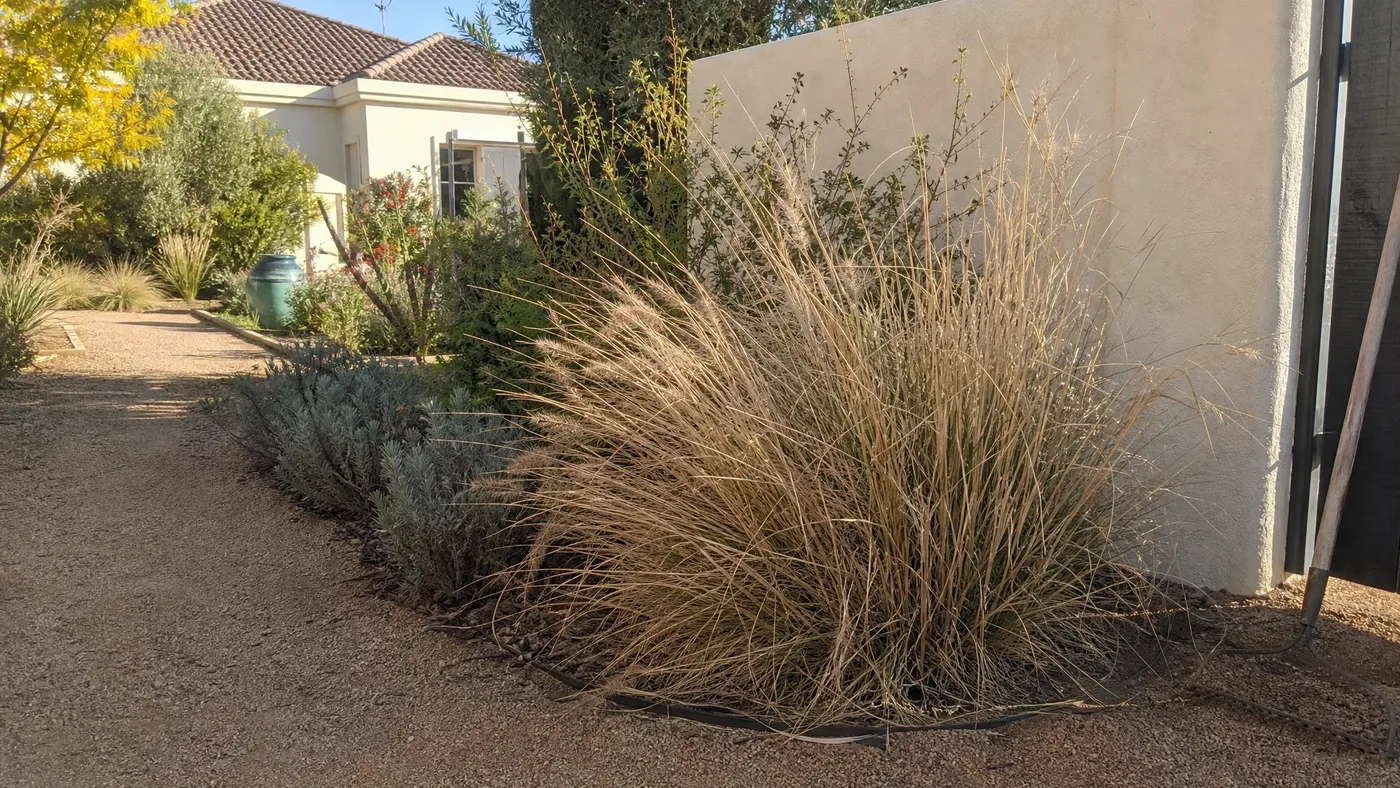
Is Karley Rose Fountain Grass Evergreen or Deciduous?
One crown, roughly four months of tan stems, and then a flush of green that people mistake for a different plant. That is a cold-zone winter for Karley Rose Fountain Grass. The question gets urgent right after the first hard frost, when the color drains out of the clump and you wonder whether it is finished.
It matters because the wrong answer costs you the plant. Cut a healthy crown at the wrong time or dig out a grass that was only asleep, and you lose a perennial that would have returned.
This article talks about whether Karley Rose keeps its foliage or drops it and answers the questions customers ask us most. Read on to learn how the crown works, what frost does to the blades, how long dormancy lasts in zone 6, where some green hangs on, when and how low to cut, and how to tell dormant from dead.
How Karley Rose Fountain Grass Stores Energy in Crowns
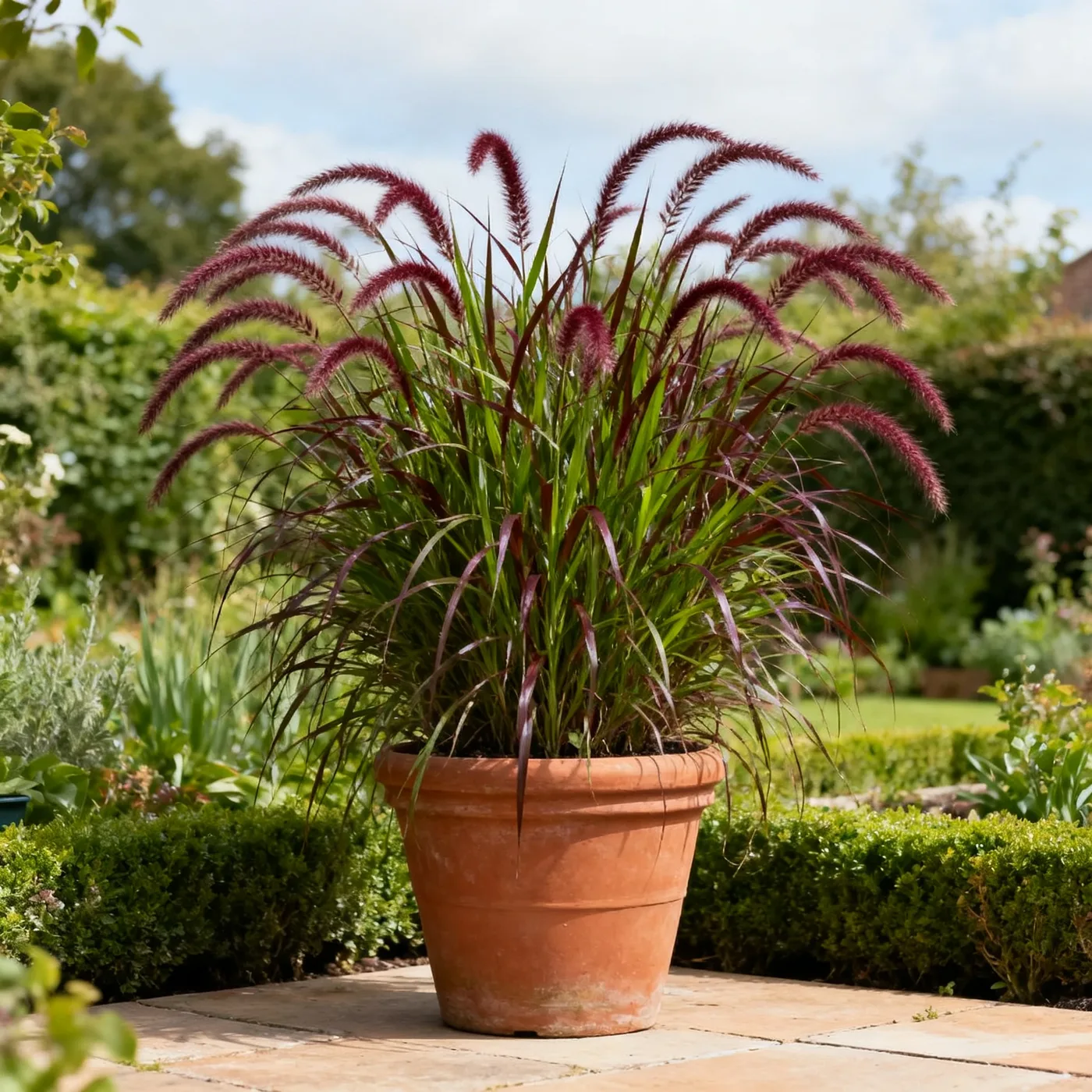
Karley Rose is a clump-forming perennial grass about 2 feet tall with arching, linear leaves, and trial plants with plumes ran taller: roughly 37 inches in a cut-flower trial and 42 inches in a second trial, both measured in year two. Blades, stems and plumes are the visible, disposable part. The permanent part sits at soil level and below.
The Crown and the Roots
The crown is a dense knot of buds at the base of the clump. Every shoot you see next year starts there. All summer the blades make sugars and send part of them down to the crown and roots, where they are banked as reserves. Once frost ends that work, the plant has already stocked its pantry. The roots stay alive in the soil and need no leaves to do it.
A Warm-Season Cycle
The species is a warm-season grass because it does not tolerate frost well. In practice that means three things. It wakes up late in spring, it grows hardest in heat, and it shuts down when cold arrives. It also flowers on that schedule, with plumes from early summer until frost. In the trials the blooms ran from June onward.
A plant built this way spends its whole growing window making leaves, stems and plumes, then drops the lot. Keeping blades through a freeze would cost it more than it gains. That is the biology behind the deciduous answer, and everything else in this guide follows from it.
What the First Hard Frost Does to Blades
Frost damages the water-filled cells in the blades. A light frost may only scorch the tips. A hard frost, the kind that holds below freezing for hours, takes the whole clump. The deep green foliage fades first to a yellowish straw and then settles to tan over days. The rose-purple plumes dry and go pale along with it. Our fall color guide covers that fade in more detail.
What you want to see is dry, upright, tan stems. That is a plant doing what it should. Black, slimy or collapsed blades at the base are something else, usually a drainage problem, and our soil and drainage guide deals with it.
Every fall, customers send us a photo of a tan clump and ask whether it is dead. It is not. Tan after frost is the plant on schedule.
Do not rush to tidy it. The standing stems shade the crown and keep the clump from flopping into a wet heap through winter. If you cut in fall because the tan looks untidy, you remove that cover and gain nothing. We leave them up until late winter.
Dormancy Runs About Four Months in Zone 6
In zone 6, plan on roughly four months of tan, standing stems between the first hard frost and the first new shoots. A cut-flower trial found the cultivar very tough and cold hardy in Zone 6, so that four-month stretch is the normal, survivable pattern there. Nothing is wrong during it. The plant is idle, not sick.
What Four Months Looks Like
Weeks one to eight look the same: tan stems, no green, nothing moving. The crown is already awake underneath long before you can see it. Plan your calendar around that. Do not judge the plant in the first half of dormancy, and do not judge it at the end either, because a cold spring stretches the wait.
The Spring Flush
New growth arrives as bright, fresh green blades pushing up through last year's tan stems. Against all that straw color, the flush looks like a different plant, or a weed grass moving in. People pull it. Do not. If it comes out of the center of the old clump, it is Karley Rose.
Zone 5 and the Cold Edge
Zone 5 is the cold edge for this cultivar. Dormancy there is longer and the margin for error is thinner. Our winter care guide covers what we tell zone 5 customers about protecting the crown.
Where Karley Rose Fountain Grass Stays Semi-Green
Milder winters change the picture. In zones 8 and 9, frost is lighter and shorter, and the blades do not always die all the way down. Part of the clump turns tan while other blades stay dull green into late winter, so the grass reads as semi-evergreen. It is not the clean green of a true evergreen, but it is far from bare.
The cultivar handles a range of about 23 to 34°F, and its foliage is still listed as deciduous. In other words, even a mild-winter plant is built to drop its leaves when the cold arrives. Semi-green is what a warm winter lets you keep, not what the plant is designed to do.
This table sums up what to expect by zone. Hardiness zones are only a guide, so check with your local extension service for your own microclimate.
| Zone | Winter foliage | What we would do |
|---|---|---|
| 5 | Fully tan, longest dormancy, edge of the range | Leave stems up, protect the crown |
| 6–7 | Fully tan for about four months in zone 6 | Leave stems up, cut in early spring |
| 8 | Tan with some green blades into late winter | Cut in late winter |
| 9 | Most semi-green, mixed with tan | Cut in late winter before shoots appear |
What we tell customers is simple. If you live in zones 5 to 7, buy it for the summer plumes and accept the tan winter. If you live in zones 8 or 9 and want reliable green in January, do not count on this grass for it. Plant evergreen shrubs beside it for winter structure. Our hardiness zone guide goes into the zone limits.
Cutting Back at Three to Four Inches
Because the leaves are disposable, cutting them is safe, provided you leave the crown alone. Cut the clump to 3 to 4 inches above the soil. That height clears the buds at the crown so the new shoots are not sliced as they emerge. It also leaves a short stubble that is easy to spot and keeps the new flush from tangling in old blades.
Timing
The standard advice is to remove dead foliage and old flowered stems in early spring before growth begins. That matches the plant's cycle: cut after the worst cold has passed but before the first shoots lift. In zones 8 and 9, where blades linger, cut in late winter and expect to remove a mix of tan and green. In zones 5 to 7, wait until the ground thaws. Cut too late and you will slice into new green.
Tools and Cleanup
Use sharp hedge shears or hand pruners. Tie the clump loosely with twine first so the cuttings come away in one bundle. Rake out the stubble and do not leave a mat of clippings sitting on the crown. For step-by-step detail, read our cutting back guide.
A word on common advice: some sources tell you to shear grasses in fall. For Karley Rose we would not, since the winter cover is worth more than a tidy bed in November.
Telling Dormant From Dead in Karley Rose Fountain Grass
A dormant crown and a dead one look the same from above. Both are tan, dry and quiet. You have to check the base. Run these checks in order after you have made the 3 to 4 inch cut.
- Look at the cut ends of the stems. Healthy ones are pale green or cream and feel moist inside. Dry, hollow, brown stems are not a good sign, but they are not proof of death either.
- Squeeze the crown at the soil line. It should feel firm and fibrous. A mushy or sour-smelling crown has rotted, and that is the real warning sign.
- Tug on a few stems. Living clumps hold tightly, while stems that pull out with no resistance point to rot at the base.
- Look for even one green shoot at the crown. One is enough to show the plant is alive.
- Wait before deciding. In zone 6, tan stems standing for about four months is normal, and a cold spring adds time. Give the soil time to warm well past your last frost date before you give up.
In our rows, the clumps that look worst in late winter are often the first to push new growth, so we hold off judging by looks alone.
If you buy a plant from us, its first winter will follow the same pattern: tan stems, then green. Treat it as dormant until the checks above say otherwise.
Karley Rose Fountain Grass Is Deciduous Almost Everywhere
Karley Rose has deciduous foliage, and that is our answer. Karley Rose is a warm-season grass that goes fully dormant and tan after frost in zones 5 to 7. The exception is zones 8 and 9, where some blades linger as semi-green into late winter. Treat that as a bonus, not a promise. The full picture is in our complete growing guide.
The rule in numbers: expect tan after frost, cut at 3 to 4 inches, and wait for new shoots before judging.
Karley Rose Fountain Grass
Nursery-grown Karley Rose Fountain Grass in sizes from Quart, shipped to your door.
From $29.99
Shop Now →Karley Rose spends its early seasons on our farms in full sun and well-drained soil, which gives the crown a sturdy base for the day it turns tan after frost. Every plant we ship is one we would grow at home, raised to top quality by our small crew. If a deciduous grass sounds right for your garden, we would love for you to choose one of ours.