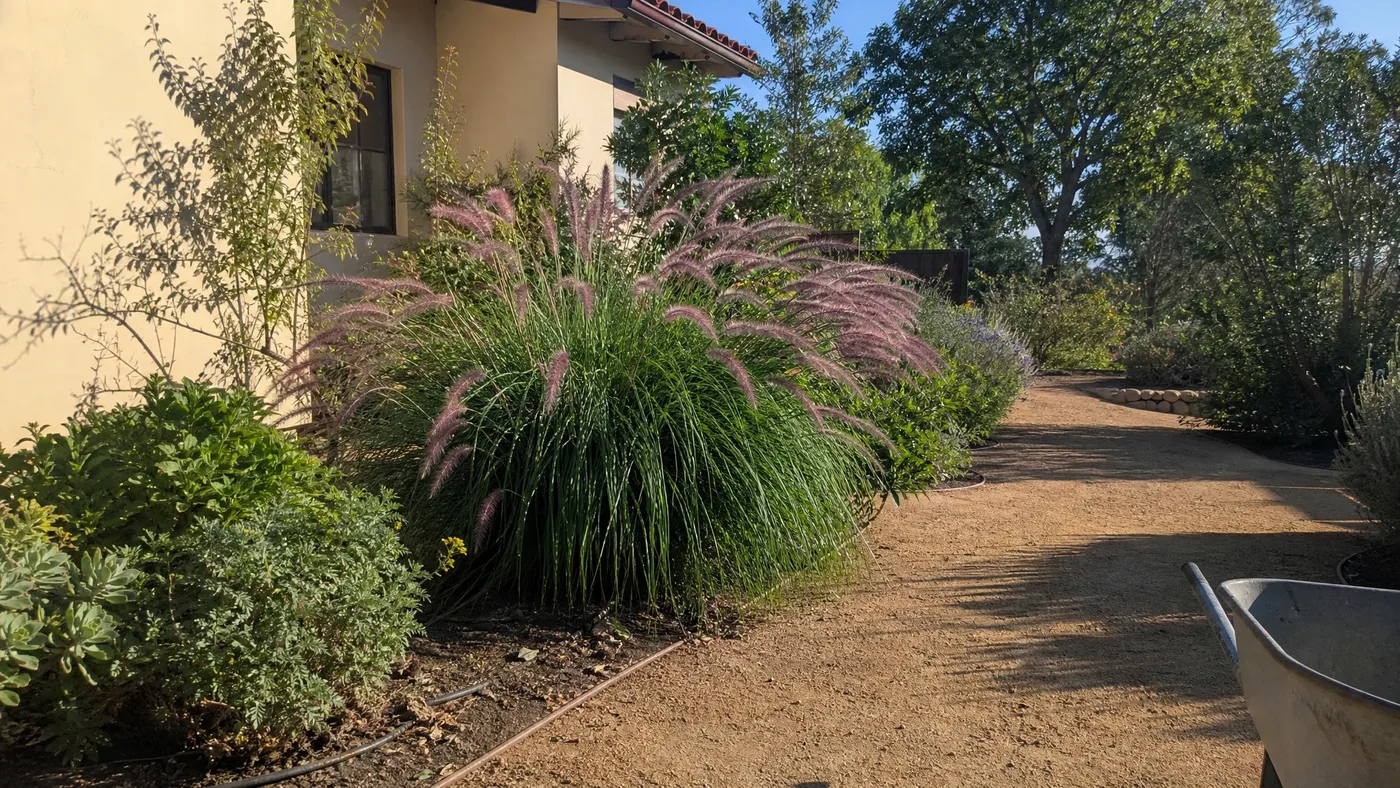
Is Karley Rose Fountain Grass Deer and Rabbit Resistant?
Walk out at dusk to the fence line and you can read the night in the mulch: a line of deer tracks, a hosta chewed to stems, and one clump of grass standing exactly as you left it. Most people don't expect that. They assume a plant with pink plumes must be on the menu, yet Karley Rose Fountain Grass is usually the one animals walk around.
The reason is the leaf. The species is deer and rabbit resistant, and the narrow, rough-edged blades give a browser very little to enjoy. Below, you'll find out all about using it as a living screen, including a deer path along a fence, rabbits on a front walk, a thin side bed, a pot on a deck, an exposed lot by the woods, and the cases where resistance fails.
A Deer Corridor Along the Back Fence
Deer are creatures of habit. They follow the same route night after night, usually along a fence, a hedge or the edge of a field, and they sample whatever is soft and easy to bite along the way. Karley Rose is a poor candidate for that sampling. The species has blades up to 2 feet long and only 1/2 inch wide, with rough margins, which means a thin, fibrous mouthful with nothing juicy in it. Planted between the path and your softer plants, the grass makes a screen the animals tend to pass by.
Set it up this way:
- Watch where the tracks and flattened mulch run for a week, then plant on that line instead of where it merely looks nice.
- Plant a continuous band with no gaps, because a gap becomes the new shortcut.
- Put the grass on the side deer approach from, and keep the tastier plants behind it.
- Give it full sun and well-drained soil, which is what the cultivar wants anyway.
- Water through the first season so the clump fills out fast.
Be realistic about height. The cultivar is about 2 feet tall, though trial plants have run taller by their second year. That makes it a low screen, not a wall. It works by discouraging a hungry animal, not by blocking one. If you want the full range of mature sizes, see how big Karley Rose really gets.
Karley Rose Fountain Grass on a Rabbit-Heavy Front Walk
Rabbits live at ground level, so they meet a plant at its most vulnerable point: the crown and the first few inches of new growth. A newly planted Karley Rose is a small clump of young blades, and young blades are the softest this grass ever gets. A mature clump is another matter. Dense, wiry foliage with rough edges is not what a rabbit goes looking for, which is why walkways are a natural home for it. The species is often used along walkways and slopes.
Protect the first season. Ring each new plant with a loose cage of wire mesh for the first weeks, and remove it once the clump has bulked up and the blades have toughened. We often see rabbits test a fresh transplant once, tug at it, and move on, but a cage costs you nothing and removes the doubt.
Winter is the other risk. When snow covers the lawn and the garden is bare, rabbits chew whatever stands above the snow. Leave the old foliage standing through winter and cut it back in early spring before new growth begins. Our guide to cutting back Karley Rose covers the timing.
A Narrow Side Bed Lined With Karley Rose Fountain Grass
A side bed between the house and a fence is often only a few feet wide, and it is a tunnel for wildlife as much as for you. Planting a single row of Karley Rose down the open edge turns that bed into one that animals read as a hedge of tough grass instead of a buffet. One row is enough. A double row wastes room, and the species can spread wider than many people expect, at 3 to 5 feet for the species, so leave space for each clump to arch outward.
Spacing in a thin bed is a tradeoff between a tight look and healthy air movement. Our spacing guide for borders and mass plantings walks through the options. Check sunlight first, though. Side beds can be shaded by the house for much of the day, and this cultivar is listed for full sun, so the grass belongs on whichever end of the bed gets the most light.
For companions, choose plants that share the grass's liking for sun and sharp drainage, and that are tough or aromatic rather than soft and lush. Your local extension service can tell you which perennials the deer in your county actually leave alone. Keep the rose-purple plumes in front, since they run from early summer until frost and carry the color of the bed.
Placing Karley Rose Fountain Grass Beside Tempting Hostas
Hostas are the classic deer snack, and they sit at the center of most browsing complaints. The trouble is that hostas want shade and Karley Rose wants full sun. You can't tuck the grass right up against a hosta under a maple and expect either to be happy. Instead, plant the grass on the sunny outer edge of the bed, where the light is better and where animals approach, and let the hostas sit behind it in the shadier ground.
Check how much sun the edge really gets. Our sun requirements guide explains why a grass that leans and thins in shade is no longer a good buffer. A weak, floppy clump looks less like a barrier and more like an open door.
Know what the buffer can and can't do. A low grass will not stop a determined deer from stepping over it to reach a prized hosta. It slows the casual browser and breaks the straight line from path to plant. If a particular hosta gets hit every year, add a repellent or a physical barrier on top of the grass, and treat the grass as one layer of defense.
A Pot on a Hot Deck
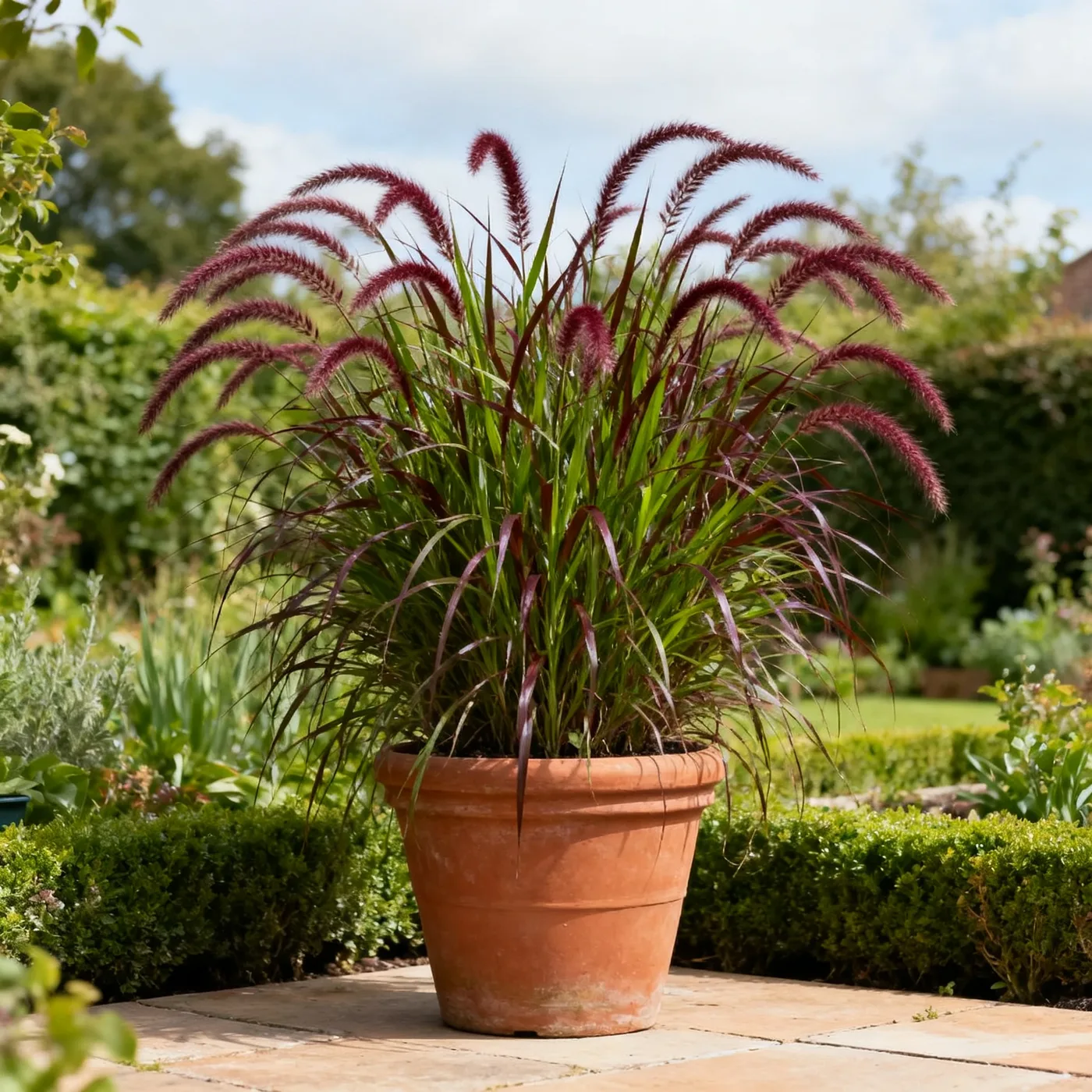
A pot raises a plant closer to a browser's mouth, and a deck adds heat. Both matter. On a raised deck, deer rarely climb the steps, but rabbits and other small animals can reach a pot on the ground or near the stairs. Karley Rose handles the heat and sun well, and the same stiff blades that put off wildlife in a bed do the job here. Place the pot against the house wall or among other pots, so the grass is not the first thing an animal meets on the way up.
Use a pot with real drainage holes and a light, well-drained mix, which suits the cultivar. Pots dry faster than ground soil, and a heavy, soggy mix is the quickest way to lose the plant. Our guide to growing Karley Rose in pots and containers covers pot size, mix and watering.
In winter, a pot is more exposed than a border, because the roots are not insulated by the ground. In a cold zone, move the pot to a sheltered spot near the house and leave the foliage standing.
A Windswept Corner Lot Near Woodland
A corner lot beside woods or open land is where browsing pressure is highest. The animals live right there, they cross your property as part of a longer route, and in late winter they run low on natural food. A scattered planting here gets sampled. A bold block of grass holds up better, and the species performs well in mass plantings.
Wind is an advantage in one way, since moving air keeps foliage dry and the grass wants well-drained, sunny ground anyway. Hardiness is the other question on an exposed lot. The cultivar seems to be very tough and cold hardy in Zone 6, but colder areas call for winter protection, and an open lot gets the worst of the cold. Read our winter care guide before you commit a whole boundary.
One more point about wild edges: the species is listed as potentially weedy, and a lot that borders wild land is where self-sown seedlings could do the most harm. Cut off spent plumes before they scatter, and ask your extension service about local concerns.
What Hungry Deer Still Might Do to Karley Rose Fountain Grass
Resistant does not mean immune. In a hard winter, when snow lies deep and the usual food is gone, deer and rabbits will eat things they normally ignore, and an ornamental grass is not exempt. Young plants are also more likely to be pulled or nibbled than established clumps. Treat any claim of total deer-proofing with suspicion, ours included. One of the most common questions we get is whether a bitten plant is a failed plant, and the answer is almost always no.
Use the damage to decide what to do next:
| What you see | Likely cause | What to do |
|---|---|---|
| A few blades nibbled and left | A taste test | Leave it and keep watching |
| Young clump loosened or pulled | Rabbits or deer tugging at a new plant | Replant, firm the soil, add a wire cage |
| Blades grazed low in late winter | Hunger when other food is scarce | Cage it through winter, cut back in early spring |
| Repeated heavy damage in one spot | A well-used animal path | Add fencing or repellent, or move the planting |
The crown usually survives, and the plant regrows in spring. If damage repeats year after year, the problem is the path or the pressure, not the grass.
Give Karley Rose Fountain Grass One Season to Prove Itself
Judge Karley Rose over a full season, not a single night. A bitten blade tells you an animal tried it, not that the planting has failed. Protect young plants, put the grass on the sunny side where animals approach, and keep the softer plants behind it. Most yards find that after the first season the animals learn to skip it, and the plumes carry on from early summer until frost.
Karley Rose Fountain Grass
Nursery-grown Karley Rose Fountain Grass in sizes from Quart, shipped to your door.
From $29.99
Shop Now →Our Karley Rose spends its whole life on our farms in bright sun and quick-draining soil, which is the spot we suggest you give it so it can stand up to a season of curious nibblers. Growing top-quality grasses is our business, and we run it as a small team that tends its own land. When you have picked a place for a deer-wary border, we hope you will browse our grasses.